While most might read the Daodejing from beginning to end, perhaps focusing on interests might reduce cognitive load.
… there is a greater degree of coherence to the Daodejing than a first reading might suggest. Chapters are sometimes grouped around specific themes and subjects. For example,
* chapters 1 and 2 are centered on the theme of correlativity, * chapters 18 and 19 contrast natural and conventional morality, * 57 through 61 all begin with recommendations on proper governing of the state, * 67 through 69 are about prosecuting war, * chapters 74 and 75 deal with political oppression and the common people,
and so on. We have appended a thematic index that reveals at least some of such editorial organization.
Ames and Hall (2003), p. 8, editorial paragraphin added
Those looking to the Daodejing for answers may be disappointed, because it only presents more questions to be considered, perhaps like listening to a song.
… when we turn to reflect on how the selected wisdom sayings of the Daodejing function, we can assume that they, like the repertoire of songs, have a kind of unquestioned veracity that comes from belonging to the people and their tradition. We can further observe that this veracity is made corporate by a reading strategy that co-opts the reader.
Two often remarked characteristics of the Daodejing are palpable absences: * it contains no historical detail of any kind, and * it offers its readers no doctrines in the sense of general precepts or universalistic laws.
The required “framing” of the aphorism by the reader is itself an exercise in nondogmatic philosophizing where the relationship between the text and its student is one of noncoercive collaboration. That is, instead of “the text” providing the reader with a specific historical context or philosophical system, its listeners are required to supply always unique, concrete, and often dramatic scenarios drawn from their own experience to generate the meaning for themselves.
This inescapable process in which students through many readings of the text acquire their own unique understanding of its insights informed by their own life experiences is one important element in a kind of constantly evolving coherence. The changing coherence of the text is brought into a sharpening focus as its readers in different times and places continue to make it their own.
Ames and Hall (2003), p. 8, editorial paragraphin added
There are a variety of translations and commentaries on the Daodejing. Ames and Hall rely on the 1982 version by D.C. Lau, that is based on the Wang Bi text.
The Daodejing comes down to us today in several different versions. How do we decide which text to take as a master for our translation? [1]
[1] In this discussion of the text, we have relied heavily upon the research and sometimes speculative insights and conclusions of D. C. Lau (1982) and Robert Henricks (1989, 2000), and would refer the reader to their fuller accounts.
Lau, D. C. (1982). Chinese Classics: Tao Te Ching. Hong Kong: Chinese University of Hong Kong Press.
Henricks, Robert (2000). Lao Tzu’s Tao Te Ching. New York: Columbia University Press.
Henricks, Robert (1989)). Lao-tzu Te-Tao Ching. New York: Ballantine.
Ames and Hall (2003), p. 73
In the Glossary of Key Terms, there is a major insight that the Daodejing should be read a processual, i.e. think verbs, not nouns!
There is one general point that we would make in our interpretation of this classical Chinese language. Above we have argued for a processual understanding of classical Daoist cosmology. If this account is persuasive, it means that the vocabulary that expresses the worldview and the common sense in which the Daodejing is to be located is first and foremost gerundive. Because “things” in the Daodejing are in fact active “processes” and ongoing “events,” nouns that would “objectify” this world are derived from and revert to a verbal sensibility. The ontological language of substance and essence that is sedimented into the English language tends to defy this linguistic priority, insisting upon the primacy of “the world” rather than the process of the world “worlding” and the myriad things “happening.” It is a fair observation that a careful reading of the introduction and this glossary are made necessary by the fact that our European languages can only most imperfectly “speak” the world being referenced in the Daodejing.
Finding proper words to express system(s) change(s) can be a challenge. One alternative could be diachrony. The Oxford English dictionary provides two definitions for diachronic, the first one most generally related to time. (The second is linguistic method)
diachronic ADJECTIVE
1. Lasting through time, or during the existing period. 1857–
1857 The two creations—the extinct and the extant—or rather the prochronic and the diachronic—here unite.
A borrowing from Greek, combined with an English element.
Etymons: Greek διά, χρόνος, ‑ic suffix.
< Greek διά throughout, during + χρόνος time + ‑ic suffix
For completeness, prochronic relates “to a period before time began:”
If we prefer an American definition over the British, Merriam-Webster emphases “change”, citing French rather than Greek origins.
diachronic adjective
: of, relating to, or dealing with phenomena (as of language or culture) as they occur or change over a period of time
Etymology borrowed from French diachronique, from diachronie DIACHRONY + –ique
Merriam-Webster.com Dictionary, s.v. “diachronic,” accessed April 10, 2024, https://www.merriam-webster.com/dictionary/diachronic.
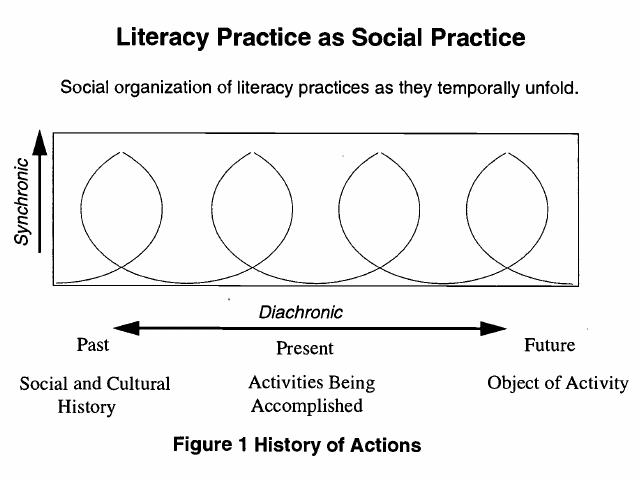
From research into situated learning, a figure illustates the distinction between synchronic and diachonic .
A 1998 manuscript would seem to be related to a 1996 dissertation by Lynda D. Stone, that would be published as a book chapter in 2000 book Vygotskian Perspectives on Literacy Research: Constructing Meaning Through Collaborative Inquiry.
… methodologically we attempt to look at both the social practice of literacy learning and the moment-to-moment construction of that practice. As a consequence, we also use theoretical perspectives of such scholars as Bakhtin (1981), Bourdieu (1977; 1991), Foucault (1977), and Goffman (1959; 1961; 1974; 1981) to more richly understand social phenomena such as social identities, hybridity, and hierachies and power relations. in learning contexts. Thus, by integrating micro and macro analyses of learning environments, we are able to investigate the social, spatial, and temporal organizational dimensions of literacy learning practices, that is, diachronic and synchronic dimensions of activity (Gutierrez, 1993,1995; Stone,1996b). [p. 4, emphasis added]
[….]
… to understand better the relationship between literacy learning and its contexts, we examine the gestalt, or the whole practice and the history of those practices in situ. Practices are socially and culturally organized and, thus, encode a social and cultural history. Practice becomes a rich unit of analysis because practices are constituted over time by multiple activities that stretch and change. Accordingly, a focus on practice makes visible the social and cultural history of the practice, an understanding of what is being accomplished in the moment, as well as an understanding of the future goal or object of activity. In Figure 1 below, we illustrate the relationship between the history of actions and the face-to-face interactional sequences that constitute the historical nature of those actions:
Figure 1 portrays the interrelationship between the “regularized acts” of situated practices occurring in the moment and the history of actions that constitutes background meaning or source of mutual knowledge used for the social production of knowledge (Giddens, 1979).
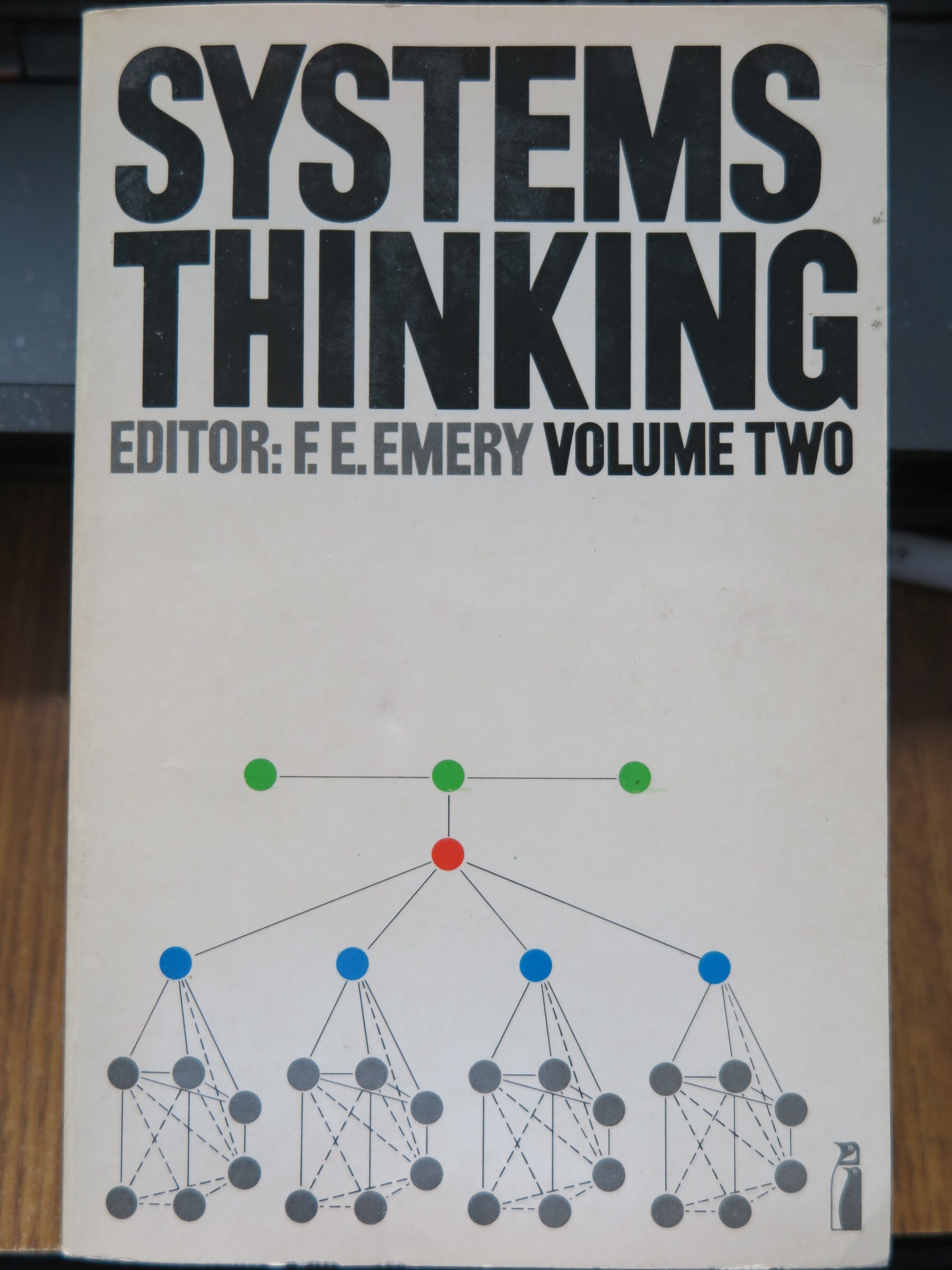
The selection of readings in the “Introduction” to Systems Thinking: Selected Readings, volume 2, Penguin (1981), edited by Fred E. Emery, reflects a turn from 1969 when a general systems theory was more fully entertained, towards an urgency towards changes in the world that were present in 1981. Systems thinking was again emphasized in contrast to causal analysis, citing Andris Angyal.
— begin paste —
Introduction
Apart from the first two introductory readings this volume tries to track some of the major fields of application of systems thinking.
They are instances, the editor believes, where old problems have been fruitfully cast in a new light by a new approach. In each instance insight has been achieved by connecting together what the disciplinary approach had rendered asunder, and by repositioning data within a newly identified superordinate system. These efforts meet Angyal’s distinction between systems thinking and causal analysis (see, in Volume 1, the Introduction to Volumes 1 and 2).
What is noticeably absent is any apparent urge towards a general systems theory. The question these studies raise appears to be ‘How many substantive systems (assembly lines, forms of subsistence agriculture, living languages) share the characteristics identified in a particular instance?’ and not, ‘How many characteristics can we find that are common to all living systems?’ (e.g. Miller, 1965). The latter pursuit seems inevitably to lead us into abstractions and back to the library. The former, as in this volume, do not bypass the libraries but must lead us to closer contact with the practical involvements of people.
What does this portend for the future of systems thinking? [p. 9]
Each of the lines of thought expounded in the first seven parts seems very likely to be a stepping-stone to further development. The problems they tackle may not be traditional problems but they are certainly ones that we now find pressing. They arise from broad changes in our world that are not likely to go away. The most general explanation for the extent and nature of this change is that western societies, at least, are shifting remorselessly from what Feibleman and Friend (Reading 2, Vol. 1) described as ‘participative, subjective’ systems where ‘the governing relation is asymmetrical dependence’ towards ‘participative, complemental’ systems where the governing relation is symmetrical dependence’. Angyal (Reading 8 herein) gives some useful criteria for following such a system change. His key point is that the conflict between system principles does not stabilize at some point of compromise. If we take a broad view of our societies it certainly seems that the new problem areas are commonly concerned with how we live, learn and communicate outside the traditional framework of dominant hierarchies. [pp. 9-10]
Why this question should now be so prominent on the human agenda is another matter (Emery, 1977). Given that it is we must expect a temporary disarray in systems thinking as each turns his mind to the task nearest to hand in his traditional part of the vineyard.
Perhaps this volume will make some contribution to a greater awareness and appreciation of the theoretical innovations of those others in diverse fields who are essentially co-workers.
Reading 26 (in Part Eight) requires some comment.
As Ackoff and I pointed out in 1972, at the end of our first attempt to define ideal-seeking systems, ‘Understanding of this aspect of system behaviour, however, seems to be essential if we are to solve the problems of adapting to the increasingly turbulent environments we are producing for ourselves’ (p. 247). We were well aware that we were doing no more than push the door ajar. The ideals themselves that we identified, as distinct from the theoretical characterization of ideal-seeking systems, seemed to have a peculiar musty flavour in a world listening to the Beatles, Bob Dylan and the like. We had, I think, been too influenced by the centuries of philosophical and theological discourse that served the myth that people’s institutions can be ideal-seeking. [p. 10]
The second reading in Part Eight could as easily have gone in with the planning papers in Part One or the governance papers in Part Seven. I chose to put it in Part Eight because the need to operationalize the pursuit of ideals is the most pressing of all of these problems and existing methodologies for this are extremely inadequate. [pp. 10-11]
References
Ackoff, R. L., and Emery, F. E. (1972), On Purposeful Systems, London, Tavistock.
Emery, F. E. (1977), Youth Victims, Vanguard or Vandals, Melbourne, National Youth Council.
Miller, J. G. (1965), ‘Living systems: cross level hypotheses’, Behavioral Science, vol. 10, pp. 380-411.
— end paste —
Source
Emery, Fred E., ed. 1981. “Introduction.” In Systems Thinking: Selected Readings, 2:9–11. Penguin Modern Management Texts. Harmondsworth: Penguin Education.
In reviewing the original introduction for Systems Thinking: Selected Readings in the 1969 Penguin paperback, there’s a few threads that I only recognize, many years later.
In the selection of papers for this volume, two problems have arisen, namely what constitutes ‘systems thinking’, and what systems thinking is relevant to the thinking required for organizational management? The first problem is obviously critical. Unless there were a meaningful answer, there would be no sense in producing a volume of readings in systems thinking in any subject. A great many writers have manifestly believed that there is a way of considering phenomena which is sufficiently different from the well-established modes of scientific analysis to deserve the particular title of systems thinking. Reasons for believing that the distinction is of value are spelt out in the first selections.
There have in fact been two arguments for a systems approach to the analysis of living phenomena.[1]
[1] Throughout the volume we have kept to the strand of thought that runs from theorizing about biological systems in general to social systems. We have practically ignored the strand that arises from the design of complex engineering systems. Through such movements as operations research and cost-benefit analysis this influence is being strongly felt by management but its methods and language are so different as to require separate treatment.
First has been the argument that only such an approach will reveal the ‘Gestalten’ properties that characterize the higher levels of organization which we call ‘living systems’. It will be noticed that we are parenthesizing the key terms. This pretty well indicates the uncertain state of knowledge in this field.
Second has been the argument that many of these Gestalten properties are common to the different levels of organization of living matter (from bacteria to human societies) and hence provide a valid and powerful form of generalization. [p. 7, editorial paragraphing added]
There is at least one further line of argument although it has had little apparent attraction to the main contributors to the systems approach. This is that a systems analysis of living organizations is likely to reveal the ‘general in the particular’. Analysis of part systems in cause-effect terms, for example, of liver disorders, death rates, recruitment, training, or productive efficiency, builds up a certain kind of knowledge. However, the total systems of which they are a part usually offer alternative paths which will minimally meet organizational requirements and/or provide substitute feedback control systems, Analysis of the total system is likely to reveal those properties, general to the species, that have enabled the species to adapt and survive in its typical environment. This line of argument clearly accepts the first argument, namely that there are Gestalten qualities of living organizations that are unlikely to be revealed by the ordinary modes of scientific analysis. It goes beyond this in suggesting that there may be properties that can be generalized to the ‘species’ and yet claim no necessary generalizability to all living systems because systems analysis presupposes a knowledge of what functions the part systems can undertake. Without this knowledge it would be very difficult indeed to determine what the total system was supposed to be coordinating and controlling. [pp. 7-8]
We posed a second question, ‘What systems thinking is relevant to the thinking required for organizational management?’ The editor believes that it has been shown that living systems, whether individuals or populations, have to be analysed as ‘open systems’, i.e. as open to matter-energy exchanges with an environment. Human organizations are living systems and should be analysed accordingly. The fact that it faces us with the task of analysing forbiddingly complex environmental interactions gives us no more of an excuse to isolate organizations conceptually than the proverbial drunk had when searching for his lost watch under the street lamp because there was plenty of light when he knew he had lost it in the dark alley. [p. 8]
A great deal of work has been done in the social sciences to elucidate the properties of social systems considered as isolated entities. We shall not draw on this material. Management is concerned with the control of social systems, technologies, and markets. Our central purpose in selection has been, therefore, to depict the emergence and clarification of the view that living systems are essentially ‘open systems’, not ‘closed systems’. Despite Koehler’s contribution (Reading 3) in 1938 and Angyal’s (Reading 1) in 1941, the major impact came from von Bertalanffy (Reading 4) in 1950. It is perhaps unfortunate that this impact gave rise to a movement for General Systems Theory along with its search for dynamic principles common to all kinds of systems living or mechanical. This movement has been attractive to those with a systems engineering orientation, but has so far failed to further its unifying mission and has tended to overshadow the carly recognition by Ashby and Sommerhoff that if living systems are to be treated as open systems we must be able to characterize their environments. [pp. 8-9]
In Part Three we present a set of papers which have sought to deal specifically with the properties of environments that are relevant to adaptive behaviour.
These efforts are all concerned with global properties of organizational environments. In this capacity these theories seem to be far removed from the specificity of organization-environment relation that Sommerhoff shows to be necessary for a science of living systems. The gap may well prove to be more apparent than real. As Gibson (1966) and Tomkins (1953) have argued, living systems probably learn and hence adapt because of their ability to react to the general and less variable properties of the environment, rather than because of their sensitivity to the concrete events and objects which do after all yield a constant flux of stimulation. Measuring organizational environments along the dimensions suggested by Simon, Ashby, and the others, may be all that is required to realize Sommerhoff’s general theory.
Part Four brings together papers that concern the extension of these notions to social systems. It will be clear that these efforts have barely begun to encompass the richness of thought exhibited in the preceding sections. There is no reason why the serious student of management should not regard this as a challenge to join in the bridging operation. To encourage this we present six principles which reach back as far as the work of Koehler in order to identify lessons of value to systems management:
1. The primary task of management is to manage the boundary conditions of the enterprise. The boundaries of an enterprise are those levels of exchange with the environment which allow it to survive and grow. They can be managed only by managing the co-variation of internal and external processes. In so far as a manager has to co-ordinate or otherwise resolve internal variances then he is distracted from his task. [p. 9]
2. The goals or purposes of an enterprise can be understood only as special forms of interdependence between an enterprise and its environment, They cannot be identified with the state of equilibrium that is the end-state for closed systems. The state of equilibrium represents a minimum level of potential energy or capacity for work. The enterprise seeks to establish and maintain those forms of interdependence that enable it to maximize its potential energy or capacity for work. As in Koehler’s example of the flame (pp. 63-5), a steady state is achieved only at the level of maximum potential energy. The form of this potential capacity and the exchanges are determined by the special forms of interdependence into which the enterprise enters, but achievement of a steady state is the most general dynamic trend in an open system. [pp. 9-10]
3. An enterprise can achieve a steady state only when there is (a) constancy of direction, i.e. despite changes in the environment or in the enterprise, the same outcomes or focal conditions are achieved. Put another way, the system remains oriented to the same end; (b) that with respect to that end, the system maintains a rate of progress toward it which is within limits defined as tolerable. A more precise statement of ‘rate of progress’ might be that the enterprise achieves the required focal condition with lesser effort, with greater precision for relatively no more effort, or under conditions of greater variability. In any of these cases, the level of exchange would be more favourable to the enterprise. One implication of this proposition is that an enterprise can have no equilibrium state such as can be found in physical systems (because in the former case, the relevant internal and external variables – are capable of independent variation)– the state of one does not automatically determine the other). A positive implication is that an enterprise cannot hope to achieve steady state (except accidentally) unless it sets a mission for itself in terms of outcomes that are capable of achievement and yet are sufficiently beyond present performance to allow for some measurable degree of progress.
4. Given the last two propositions, the task of management is governed by the need to match constantly the actual and potential capacities of the enterprise to the actual and potential requirements of the environment. Only in this way can a mission be defined that may enable an enterprise to achieve a steady state. However, the actions of management cannot in themselves constitute a logically sufficient condition for achievement of a steady state. [p. 10]
5. A ‘steady state’ for the system cannot be achieved by any finite combination of regulatory devices or mechanisms that are aimed at achieving a steady state for some partial aspect of the system such as input-output rates, internal change, or environmental contact. In a human organization, the two requirements for a steady state, unidirectionality and progress, can be achieved only by leadership and commitment. The end-state of the system must be clearly enough defined and agreed upon to enable the system to be oriented toward it regardless of a wide range of changes in their relations. Secondly, the members of the organization must be so committed to the end-state that they will respond to emergencies calling for greater efforts. The basic regulation of open systems is thus self-regulation — regulation that arises from the nature of the constituent parts of the system. [pp. 10-11]
One corollary is that it is only within this framework that regulatory mechanisms, such as cost controls, can make an effective contribution. In creating these mechanisms it is essential to ensure that they do not run counter to, or undermine the requirements for self-regulation, and to remember that mechanisms which are appropriate in one phase of a system’s existence may, with a change in location with respect to the mission, become inappropriate.
The measure of whether these processes of self-regulation are operating effectively, of whether the system is healthy and maturing, is to be found in the steady growth of potential capability with respect to the mission. In the case of any enterprise, the critical question at any time is whether it is more capable than before of fulfilling the tasks arising from its mission. A good record of recent performance, e.g. high profit yield, would not in itself exclude the possibility that potential capacity had in fact been reduced.
6. An enterprise can only achieve the conditions for a steady state if it allows to its human members a measure of autonomy and selective interdependence. This proposition is clear enough when applied to organizations composed of professionals. It is less clear that it applies to enterprises in general because it introduces an assumption which is new in this context, namely that individuals themselves have open-system characteristics and can be related to each other or to organizations only in ways that are appropriate to such systems. In particular, commitment presupposes that the individual has sufficient autonomy to exercise choice. The requirement that the co-ordination of components be maximally brought about by themselves (proposition five) requires some sacrifice of autonomy and to that extent threatens commitment. This threat can be lessened by allowing selective interdependence.
These principles barely draw upon the potential of systems theory for management theory. They also show little evidence of a coherent and comprehensive theory from which such principles could be rigorously deduced. Nevertheless it is in finding new ways of looking at things that men have managed in the past to advance scientific understanding. [p. 11]
We have tried to select readings that would excite readers to a new way of looking at mundane realities of human organization. They have been arranged to lead from the earlier to the later papers and from consideration of systems in general to social systems in particular.
For Part One we have selected the earlier papers that explicitly or implicitly argue for a new logic in the study of complex systems that display purposive or adaptive behaviour. What these authors have in mind is something more than the model of causal analysis usually associated with the physical sciences; it is also something less than a rigorous predictive theory of some restricted area of behaviour. This latter feature has occasioned some misguided criticism to the effect that theories that cannot predict and hence cannot be experimentally confirmed or disconfirmed are not scientific theories. Such criticism overlooks the all-important role in scientific development of our guiding metaphors and our principles for mapping the real world (Kuhn, 1962). If systems theorizing improves the ‘internal coherence, implicative structure, freedom from the clutter and comprehensiveness’ (Chein, 1967) of the maps we make of human organizations, then we must judge it as a scientific advance.
The selections in Part One only partly argue their case by pointing to principles of system action that can be inferred from their definition of a system. However, the papers in the remaining sections were specifically selected to sample the variety of efforts that have been made to meet scientific requirements of coherence, mplicative structure, etc. These efforts have been very varied. It is almost as if the pioneers, while respectfully noting each other’s existence, have felt it incumbent upon themselves to work out their intuitions in their own language, for fear of what might be Jost in trying to work through the language of another. Whatever the reason, the results seem to justify this stand-offishness. In a short space of time there has been a considerable accumulation of insights into system dynamics that are readily translatable into the differing languages and with, as yet, little sign of the divisive schools of thought that for instance marred psychology during the 1920s and 1930s. Perhaps this might still happen if some influential group of scholars prematurely decide that the time has come for a common conceptual framework. [p. 12]
To give ready access to this variety we decided to select in terms of individual theorists instead of conceptual areas such as coordination, control, regulation, temporal integration. Likewise, to allow space for each theorist to develop his body of concepts and principles we have had to restrict the range of the sample and to leave out articles of great merit as well as those which are essentially polished rehashes or reviews. We can only hope that the heaviness of the resulting selection will be found justified by the number of unmined diamonds that exists in even the earliest.
The importance of a solid ground in this new and explosive field is such that we have not tried to depict the frontiers of systems theorizing, except in the last section introducing notions of systems management. For those wishing to extend their range of coverage in the areas represented here they could do no better than turn to the General Systems Yearbooks. For those eager to see what is happening at the frontiers the best single source is probably the journal Artorga.
The editor is grateful to the Center for Advance Studies in the Behavioral Sciences, Stanford, for the peace and quiet he needed to prepare these Readings.
References
CHEIN, I. (1967), “Versity vs. truth in the scientific enterprise’, address to Division of Philosophical Psychology, American Psychological Association, 3 September.
GIBSON, J. J. (1966), The Senses Considered as Perceptual Systems, Houghton Mifflin.
KUHN, T. (1962), Structure of Scientific Revolutions, University of Chicago Press.
TOMKINS, S. S. (1953), Affect, Imagery and Consciousness, Springer, vol. 1.
— end paste —
The diligent reader may also be interested in “World Hypotheses, Contextualism, Systems Methods“, with an excerpt from “Part One: Precedents to Systems Theory”, that highlights the omission of Stephen C. Pepper, for reasons of space.
The four concepts are: (i) interrelationships; (ii) perspectives; (iii) boundaries; and (iv) dynamics.
At 16m36s into the recording, the debate turned to Jackson for a response.
[16m36] Thanks, Barb. I’m concerned with the way in which we use systems thinking in evaluation. I’ll try and pick out some issues that I see with the Systems Concepts approach, which means the use of interrelationships, perspectives, boundaries, and dynamics in evaluation practice.
[17m00s] And to make the case for what I think is the clearer guidance that Critical Systems Practice can give.
[17m09s] A problem with the concepts is that they don’t reflect the full range of systems thinking or the full range of systems approaches.
[17m20s] They’re actually a relatively narrow set of concepts if you look across the systems field.
[17m30s] If you were to take one of the best known system thinkers, Peter Checkland, he comes up with a notion that the key consistent concepts are communication and control (cybernetic concepts) and emergence and hierarchy.
[17:47] Patrick Hoverstadt, who is the the chair of System and Complexity in Organizations, the UK professional body for systems thinking, comes up with 33 systems principles in his recent book The Grammar of Systems.
[18m05s] I think it’s not doing systems thinking justice, and possibly not doing evaluation much good, just to stick to four concepts out of the very many that exist in systems thinking, all reflecting upon different systems approaches. So that’s my first point.
[18m26s] My second point is that I feel that the the concepts can be interpreted very differently by different people, according to their existing world views, and that concepts on their own, separated from the world views or the historical theoretical traditions which make them meaningful, are actually relatively empty, and meaningless.
[18m56s] You have to see concepts within a system of signs, a language game, which gives them meaning.
[19m07s] So for example, the concept of interrelationships in System Dynamics, that means causal relationships in feed forward and feedback loops.
[19m18s] In Soft Systems Methodology, interrelationships refers to the relationships between different stakeholders and their particular world views.
[19m30s] And so totally different to meanings there. And I could say the same for all of the concepts.
[19m36s] So boundaries in System Dynamics means all those things which you regard as endogenously influential on the system.
[19m48s] Boundaries in Critical Systems Heuristics means what values are, what facts are included, in a particular decision to change something some way, and which are excluded, and what the impact that has upon stakeholders.
[20m05s] So, unfortunately, I think the the concepts are pretty meaningless unless you take them back to their root metaphors or the intellectual traditions from which they emerge.
[20m14s] Now the danger of that, for me, is that the people who are using these concepts are likely to interpret them according to their existing world views.
[20m25s] And as we know, the tradition in much of evaluation and in much management theory is to go back to the mechanistic perspective.
[20m33s] And I feel that people will have no difficulty whatsoever interpreting these concepts according to a mechanistic worldview that they already have.
[20m43s] Therefore, I argue that the clearer guidance offered by the range of systems methodologies which are Incorporated within critical systems practice can provide clearer more precise guidance and is a better way of using systems approaches and evaluation.
Most listeners would not be aware that, with root metaphors, Michael C. Jackson is referring to Root Metaphors described by Stephen C. Pepper, or Root Metaphor Theory.
How might the quality of an action research initiative be evaluated?
— begin paste —
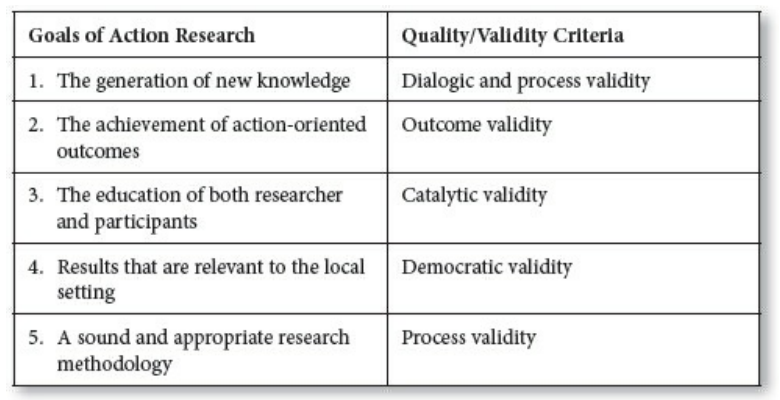
We have linked our five validity criteria (outcome, process, democratic, catalytic, and dialogic) to the goals of action research. Most traditions of action research agree on the following goals: (a) the generation of new knowledge, (b) the achievement of action-oriented outcomes, (c) the education of both researcher and participants, (d) results that are relevant to the local setting, and (e) a sound and appropriate research methodology. Based on these goals, we have identified indicators of quality for action research studies. In Table 4.1 we show how these goals are linked to validity criteria. [p. 67]
Goals of Action Research
Quality / Validity / Criteria
1. The generation of new knowledge
Dialogic and process validity
2. The achievement of action-oriented outcomes
Outcome validity
3. The education of both researcher and participants
Catalytic validity
4. Results that are relevant to the local setting
Democratic validity
5. A sound and appropriate research methodology
Process validity
Table 4.1 Anderson and Herr’s Goals of Action Research and Validity Criteria
Outcome Validity. One test of the validity of action research is the extent to which actions occur, which leads to a resolution of the problem that led to the study. Greenwood and Levin (2006) call this criteria workability and link it to John Dewey’s notion of pragmatism. Watkins (1991) points out that “many Action Research studies abort at the stage of diagnosis of a problem or the implementation of a single solution strategy, irrespective of whether or not it resolves the presenting problem” (p. 8). Brooks and Watkins (1994) suggest skillfulness as action research’s equivalent to credibility for naturalistic inquiry or validity for positivist research. Action researchers must be competent at both research procedures and moving participants toward successful action outcomes. [pp. 67-68]
Jacobson (1998) uses the term integrity to discuss his criteria for good action research. Integrity must rest on “the quality of action which emerges from it, and the quality of data on which the action is based” (p. 130). Thus, outcome validity is synonymous with the “successful” outcome of the research project. This, of course, begs the question raised below under democratic validity, that is, successful for whom? Outcome validity also acknowledges the fact that rigorous action research, rather than simply solving a problem, forces the researcher to reframe the problem in a more complex way, often leading to a new set of questions or problems. This ongoing reframing of problems leads to the spiraling dynamic that characterizes the process of most action research over a sustained period of inquiry.
Process Validity. This asks to what extent problems are framed and solved in a manner that permits ongoing learning of the individual or system. In this sense, outcome validity is dependent on process validity in that, if the process is superficial or flawed, the outcome will reflect it. Are the “findings” a result of a series of reflective cycles that include the ongoing problematization of the practices under study? Such a process of reflection should include looping back to reexamine underlying assumptions behind problem definition (Argyris et al., 1985). Process validity must also deal with the much-debated problem of what counts as evidence to sustain assertions, as well as the quality of the relationships that are developed with participants. [p. 68]
Here, some criteria might be borrowed from naturalistic inquiry, depending on how evidence is defined. The notion of triangulation, or the inclusion of multiple perspectives, guards against viewing events in a simplistic or self-serving way. Triangulation also can refer to using a variety of methods—for example, observation and interviews—so that one is not limited to only one kind of data source. Process is not, however, limited to method. In narrative and essayist forms of inquiry, there are distinct criteria for what makes a good empirical narrative (as opposed to fiction). Connelly and Clandinin (1990) warn that “not only may one ‘fake the data’ and write a fiction but one may also use the data to tell a deception as easily as a truth” (p. 10). (For an elaboration of validity criteria for narrative research, see Connelly & Clandinin, 1990; Heikkinen, et al., 2007.) [pp. 68-69]
Democratic Validity. This refers to the extent to which research is done in collaboration with all parties who have a stake in the problem under investigation. If not done collaboratively, how are multiple perspectives and material interests taken into account in the study? For example, are teachers, nurses, social workers, or CEOs using action research to find solutions to problems that benefit them at the expense of other stakeholders? Are patients, clients, students, and community members seen as part of the insider community that undertakes this type of research, or are they viewed as outsiders by action researchers? Even when collaboration takes place, how deep does it go and how wide does it extend? While process validity depends on the inclusion of multiple voices for triangulation, democratic validity views it as an ethical and social justice issue.
Another version of democratic validity is what Cunningham (1983) calls local validity, in which the problems emerge from a particular context and in which solutions are appropriate to that context. Watkins (1991) calls this relevancy or applicability criteria for validity (i.e., how do we determine the relevance of findings to the needs of the problem context?) (p. 15). Drawing on Bronfenbrenner (1979), Tandon et al. (2001) use the term ecological validity, or the degree to which the constructs and products of the research are relevant to the participating group.
Catalytic Validity. This is “the degree to which the research process reorients, focuses, and energizes participants toward knowing reality in order to transform it” (Lather, 1986, p. 272). In the case of action research, not only the participants, but the researchers/practitioners themselves must be open to reorienting their view of reality as well as their view of their role. All involved in the research should deepen their understanding of the social reality under study and should be moved to some action to change it (or to reaffirm their support of it). The most powerful action research studies are those in which the researchers recount a spiraling change in their own and their participants’ understandings. This reinforces the importance of keeping a research journal in which action researchers can monitor their own change process and consequent changes in the dynamics of the setting. While this criteria overlaps with process and democratic validity, it highlights the transformative potential of action research, which makes it so appealing to many critical pedagogues, organization and staff developers, and change agents.
Dialogic Validity. In academic research, the “goodness” of research is monitored through a form of peer review. Research reports must pass through the process of peer review to be disseminated through academic journals. Many academic journals even provide opportunities for researchers to engage in point–counterpoint debates about research. A similar form of peer review is beginning to develop within and among action research communities. Many action research groups are forming throughout North America, as action researchers seek dialogue with peers. In addition, refereed publishing venues for action research have increased dramatically in the last decade. This is particularly important for those doing action research dissertations, since those who take academic jobs will need to publish their work. [p. 69]
Dialogic validity is similar to democratic validity but differs in that the focus is less on broad inclusion than on the validation—both during and after the study—that methods, evidence, and findings resonate with a community of practice. To promote both democratic and dialogic validity, some have insisted that action research should only be done as collaborative inquiry (Torbert, 1981; Carr & Kemmis, 1986). Others simply suggest that action researchers participate in critical and reflective dialogue with other action researchers (Martin, 1987) or work with a critical friend who is familiar with the setting and can serve as devil’s advocate for alternative explanations of research data. When the dialogic nature of practitioner inquiry is stressed, then studies can achieve what Myers (1985) calls “goodness-of-fit with the intuitions of the practitioner community, both in its definition of problems and in its findings” (p. 5).1
1 Bray, Lee, Smith, and Yorks (2000) provide another approach to doing collaborative research while carving out individual dimensions of the research.
All of the above validity criteria for action research are tentative and in flux. [p. 70]
— end paste —
Reference
Herr, Kathryn, and Gary L. Anderson. 2015. “Quality Criteria for Action Research: An Ongoing Conversation.” In The Action Research Dissertation, 2nd ed., 63–79. Thousand Oaks, CA: SAGE Publications Inc. https://us.sagepub.com/en-us/nam/the-action-research-dissertation/book239688.
After 90 minutes on phone and online chat with WesternUnion, the existence of the canton of Ticino in Switzerland is denied, so I can’t send money from Canada. TicinoTurismo should be unhappy. The IT developers at Western Union should be dissatisfied that customer support agents aren’t sending them legitimate bug reports
I initially tried the online chat, and was unable to find a way to reach an agent. From Canada, calling into Western Union Customer Care at 1-800-235-0000 only led to a suggestion to call Western Union Switzerland at +32-02-639-7109, that is not a toll-free call. The agent was unable to connect me directly.
Waiting on hold, I then tried the online chat again, and managed to reach an agent. I let the agent on the phone off. After some newbie questions, the online agent asked for a screen capture of the problem page, that I uploaded into the chat window.
After having started the chat session with a clear definition of the problem, the agent denied that this was a server software issue.
Although I offered to send a screen shot of the problem, the agent didn’t seem to want that. I created a screen capture, anyway.
In the end, the agent informed me that I couldn’t have a recipient in Chiasso, Ticino, Switzerland!
After this, the agent stopped responding, and I noticed the countdown timeout approaching.
A complaint from a customer is an opportunity to welcome learning. This is my first time using Western Union, and I’m not impressed.
A critical review of the Aesthetics entry specifically mentions Pepper. The section on Aesthetics doesn’t seem to follow the “clans” with a British orientation, with American and/or Continental points of view.
One of the articles that overrides to an admirable extent the clannishness exhibited thus far is the entry on “Aesthetics” by Stephen Pepper and Thomas Munro. The discussion not only includes the historical and contemporary options of the West, but also considers in some detail the interpretations presented by the Orient, the special province of Thomas Munro in this work. This is the only article in the systematic section that gives substantial attention to the Orient, a direction future editors of the Encyclopaedia should be encouraged to follow as a matter of policy in an increasingly global society. And at the same time, the article exhibits more than casual acquaintance with work being done in the sciences on aesthetics. Pepper recommends the study of aesthetics, among other things, as a case study for the philosophy of science, for it is a discipline in process of breaking away from philosophy to become a specialty in its own right. [p 727]
Philosophy is thus viewed as general comprehension and the seat of future specialties. Pepper basically divides approaches to the field into naturalist-hedonistic theories which have been developed in the direction of the scientific approach, and “non-scientific” approaches. The latter category begins with Kant’s analysis of the insight into deeper values afforded by the genius through the harmonization of understanding and sensibility. It includes contextualist emphases upon the qualities that are the objects of experience, organistic emphases upon the wholeness of experience with its objects, formistic emphases upon imitation of the object, expressionist theories, mystical theories as well as linguistic analytical theories. The Oriental section underscores the mystical interpretation, though Munro goes out of his way, by repeating it several times, to claim the possibility of a naturalist interpretation. Pepper’s conclusion calls for an integration of the varying non-scientific approaches with the scientifie, since the aesthetic ought not only to be studied “from without,” but most especially lived through and reflected upon “from within.” [pp. 727-728]
Two deficiencies in an otherwise excellent article might be noted. The limitation of Plato’s notion of art to imitation omits the distinction between imitative artists and divine artists in the Phaedrus and fails to consider Plato’s own practice in myth-making at the end of the Republic. Secondly, Pepper’s description of the limitation of Gestalt theory to dealing with the object does not give any attention to the Leipzig Gestaltists Felix Krueger, Wilhelm Stern, and Philipp Lersch who focused attention upon the status of feeling. But these are minor limitations in an otherwise admirable exposition. [p. 728]
Reference
Wood, Robert E. 1977. “Philosophy in the New Encyclopaedia Britannica.” The Review of Metaphysics 30 (4): 715–52. https://www.jstor.org/stable/20126990
For scholars seeking references to the articles published in special issue of Paunch (1980) on the work of Stephen C. Pepper, the pursuit will seem elusive. Fortunately, the editor in chief, Art Efron, put the contents on the open Internet. Although he’s Efron has since retired and the web pages are gone, the content has been preserved on the Internet Archive!
This issue of Paunch is devoted entirely to the philosophy of S.C. Pepper. Eventually all twenty of the essays will be available at this site including the painting by Hiroshige, “The Shono Station.” The essays will be individually listed on this page but can also be accessed through the Table of Contents by clicking on Paunch link at the beginning of this paragraph.
The 221-page issue was reviewed in a variety of philosophy journals.
This special edition edition of of Paunch magazine magazine presents essays on Stephen C. Pepper’s theory of root metaphor, developed in in World Hypotheses, and its extensions to aesthetics aesthetics and art criticism. [p. 90] [….]
The order of presentation of these essays generally follows Pepper’s original view, beginning with the general theory of root metaphor in metaphysics, then moving to more special applications in aesthetics. Arthur Efron in a 42-page Introduction indicates that Pepper’s attempt was not to devise a metaphysical theory, but to determine a procedure for testing truth claims, a method for understanding any metaphysical theory. And Pepper clearly saw here no sharp division between philosophy, psychology (especially psychology of visual perception), and physiology. Pepper, Efron claims, “is the only one to argue consistently that actually there are only four or five relatively adequate views” in metaphysics. Relations may be found here, however, with Irwin Edman’s Four Ways of Philosophy, which was published in 1937, the same year as Aesthetic Quality. There is no question that Pepper was in close contact not only with Dewey but with Edman as well—Columbia University’s professor of “Philosophy of Art and Theory of Criticism.” Elmer H. Duncan writes about why he believes “Pepper should be considered one of the greatest philosophers of this century” (p. 64). Of the general commentators on Pepper’s theory of root metaphor, only Charles Hartshorne is seriously negative. [p. 91] [….]
It is clear that the hope of many of these writers is to help rectify the eclipse of Pepper’s metaphysical and aesthetic theory by the domination in recent decades of analytical philosophy. But the suggestion in many places that the significance of Pepper’s thought is to be found in its practical application—not only to art criticism, but to psychology, gerontology, the teaching of humanities, or even to library science (see p. 34) — bypasses the kind of logical argument needed to defend the significance of Pepper’s thought on a philosophical level. The telling criticisms of Hartshorne or Yanal remain unanswered by notes of practical usefulness.
Pepper’s work in aesthetics was closely linked to his contributions to value theory and to metaphysics. In value theory he extended the cognitive naturalism of Ralph Barton Perry in conjunction with the purposive behaviorism of Edward Tolman. In 1947 Pepper presented his value theory in compact form in A Digest of Purposive Values, and elaborated it in comprehensive, technical detail in Sources of Value (1958). His textbook, Ethics (1960), offers a social adjustment theory of morality; it contains, in compressed and elementary form, his general theory of value based on the concept of the selective system as the unifying principle. In metaphysics, Pepper’s book, World Hypotheses (1942), is a minor, contemporary classic. Against the anti-metaphysical positivisms of his time, Pepper treated metaphysical theories as world hypotheses, and traced their origin to root metaphors drawn from ordinary experience. He then argued that there are only four adequate world hypotheses – formism, mechanism, organicism, and contextualism; and, further, that these world hypotheses are equally adequate and autonomous. Then in his 1961 Carus lectures, published as as Concept and Quality (1967), Pepper advanced a fifth world hypothesis — selectivism — as his own. [pp. 66-67].
Despite the quantity and quality of his works, Pepper, like so many of his philosophical compatriots, has been neglected by the contemporary American community of professional philosophers. Perhaps the present volume under review will usher in a period of deserved critical appre- ciation of Pepper’s thought, although it is noteworthy that its editors, Arthur Efron and John Herold, are not professional philosophers, but an English professor and a professor of literature and music appreciation respectively. Nonetheless, the volume of essays they have assembled and to which they have ably contributed will reward the attention of philosophers. Arthur Efron introduces the volume with a long essay (pp. 5-53) which provides not only a probing interpretation of Pepper’s thought but also a helpful overview of significant commentary on it, including the contents of the volume under review. For a judicious assessment of Pepper’s continuing value, Efron’s essay is highly recommended. [p. 67]
Reck, Andrew J. 1981. Review of Review of Root Metaphor: The Live Thought of Stephen C. Pepper, by Arthur Efron and John Herold. Transactions of the Charles S. Peirce Society 17 (1): 65–69. https://www.jstor.org/stable/40319904 .
In the poetry collection of the University of Buffalo is a collection of “Paunch Magazine records (Art Efron)” with the note, “This collection has not yet been fully processed”.
Paunch, the journal of literary criticism founded by longtime UB English faculty member Art Efron, endured for 37 years and became a home for radical ideas and different genres.
Efron, who retired from UB in 2005 after more than 40 years on the faculty, will share behind-the-scenes stories of Paunch ….
Wuetcher, Sue. 2016. “Efron to Share Behind-the-Scenes Stories of Paunch.” Research News. UBNow (blog). May 16, 2016. https://www.buffalo.edu/ubnow/stories/2016/05/efron-paunch-literary-criticism-journal.html .











 In brief. David Ing.